IP Speaker/Add to LumiCenter via External IP: Difference between revisions
From Luminys WIKI
Techsupport (talk | contribs) |
Techsupport (talk | contribs) |
||
| Line 17: | Line 17: | ||
<br>NAT ONVIF Port is the Onvif public port, also for device adding. | <br>NAT ONVIF Port is the Onvif public port, also for device adding. | ||
[[File:IPSpeakertoLumiCenter1a.png|400px| | [[File:IPSpeakertoLumiCenter1a.png|400px|link=https://wiki.luminyscorp.com/images/a/a0/IPSpeakertoLumiCenter1a.png]] | ||
[[File:IPSpeakertoLumiCenter1b.png|400px| | [[File:IPSpeakertoLumiCenter1b.png|400px|link=https://wiki.luminyscorp.com/images/e/ea/IPSpeakertoLumiCenter1b.png]] | ||
Revision as of 12:12, 3 June 2026
Description
This is used in LumiCenter to remotely add an IP speaker and enable audio playback and two-way communication.
Prerequisites
- The IP speaker must be on a network with a static public IP address.
- The IP speaker firmware must be version V1.43.1(260522B) or later.
Step by Step Instructions
Initial IP Speaker Setup
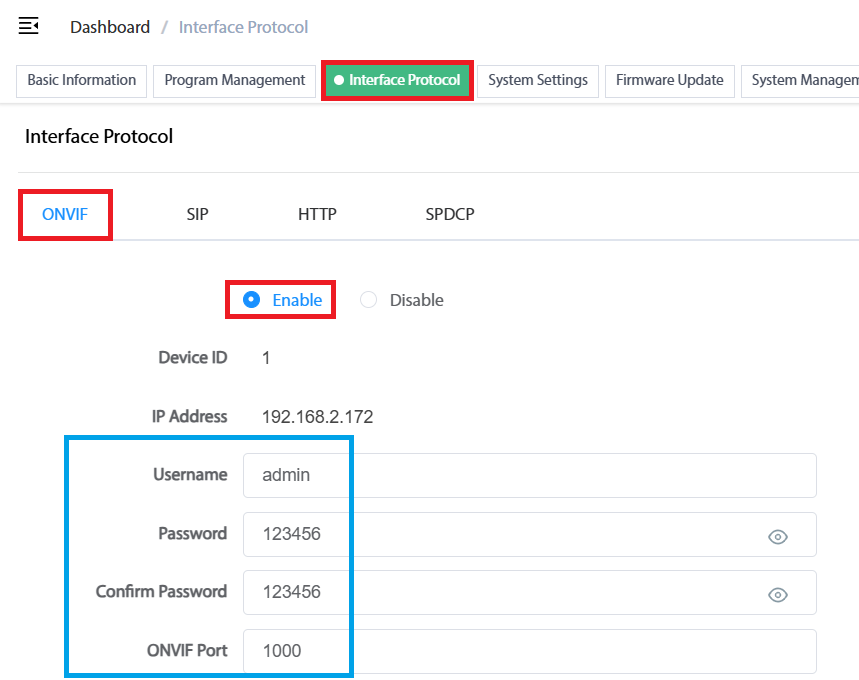
1. Parameters setting for IP speaker:
After login, go to the setting of “Interface Protocol” - “ONVIF” tap – “Enable”.
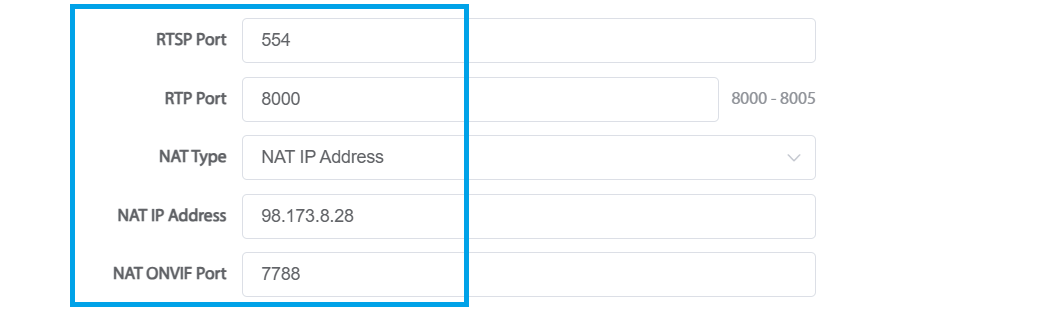
Define “Username”, “Password”, “Onvif Port”, “RSTP Port”, RTP Port”, “NAT IP Address”, and “NAT ONVIF Port”, below images as reference:
Tip: RSTP Port is recommended as 554.
RTP Port ranges from 8000-8005 and should be set as UDP while forwarding setting.
NAT IP Address is the static IP address of the network.
NAT ONVIF Port is the Onvif public port, also for device adding.